

 Home /
 ¿Cómo elegir un paquete de baterías de litio personalizado para dispositivos médicos?


Table of Contents
- ¿Qué voltaje debe usar una batería de dispositivo médico?
- ¿Cuánta capacidad de batería necesita un dispositivo médico?
- ¿Por qué son importantes las corrientes continuas y las corrientes de pulso?
- LiPo o Li-ion cilíndrico: ¿Cuál es mejor para dispositivos médicos?
- ¿Se puede diseñar la batería alrededor de la PCB?
- ¿Qué funciones del BMS son importantes para los paquetes de baterías médicas?
- ¿Qué certificaciones deberían considerarse?
- ¿Qué información debe enviarse al fabricante de baterías?
- ¿Cómo soporta GLOFLUX proyectos personalizados de baterías de dispositivos médicos?
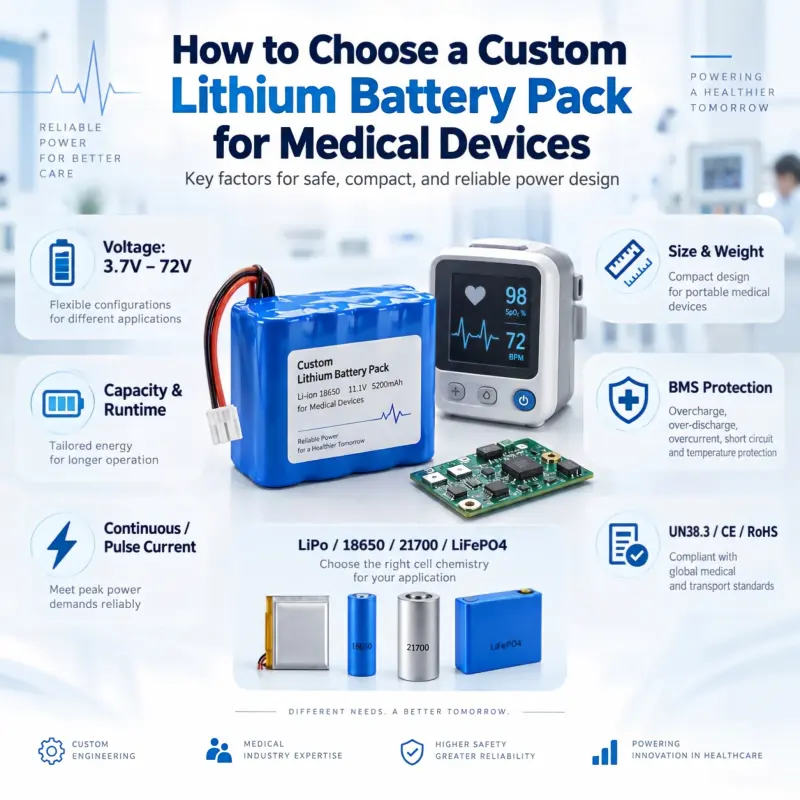
Elegir el paquete de baterías adecuado para un dispositivo médico implica mucho más que igualar el voltaje y la capacidad. Los ingenieros también deben tener en cuenta el tiempo de funcionamiento, la corriente de descarga, el tamaño, el peso, el método de carga, la protección de seguridad, el diseño del conector, el entorno operativo y los requisitos de certificación.
Para equipos médicos portátiles, sistemas de monitorización, dispositivos portátiles, instrumentos de diagnóstico y otras aplicaciones recargables, la batería debería evaluarse idealmente junto con la PCB y la estructura mecánica desde una fase inicial de desarrollo. Esto ayuda a evitar problemas como un tiempo de funcionamiento insuficiente, grosor excesivo, rendimiento inestable en corriente pico o costosos rediseños posteriores.
A continuación, se presentan las preguntas clave que los ingenieros deberían considerar al seleccionar un paquete de baterías de litio personalizado para dispositivos médicos.
¿Qué voltaje debe usar una batería de dispositivo médico?
El voltaje de la batería requerido depende principalmente de la arquitectura electrónica y los requisitos de energía del dispositivo.
Las configuraciones comunes de baterías de litio incluyen:
- 1S: aproximadamente 3,7V
- 2S: aproximadamente 7,4V
- 3S: aproximadamente 11,1V
- 4S: aproximadamente 14,8V
- Configuraciones de series superiores para equipos portátiles de mayor tamaño
Algunos dispositivos médicos compactos pueden funcionar desde una sola celda de litio, mientras que bombas, equipos portátiles de diagnóstico, carritos médicos móviles o sistemas accionados por motor pueden requerir paquetes de mayor voltaje.
GLOFLUX soporta configuraciones personalizadas de baterías recargables desde aproximadamente3,7V a 72V, típicamente deDe los 1 al 20, dependiendo de la química de la batería, capacidad, requisitos de descarga y aplicación.
El mejor voltaje debe seleccionarse junto con la arquitectura de conversión DC/DC del dispositivo, en lugar de simplemente elegir el voltaje de batería más alto posible.
¿Cuánta capacidad de batería necesita un dispositivo médico?
La capacidad de la batería debe calcularse según el consumo de energía del dispositivo y el tiempo de funcionamiento requerido.
Un cálculo básico es:
Energía de la batería (wh) = voltaje × capacidad de la batería (ah)
Por ejemplo, una batería de 11,1V 2Ah proporciona aproximadamente:
11,1V × 2Ah = 22,2Wh
Sin embargo, el tiempo real de operación puede ser menor debido a:
- Pérdidas en conversiones DC/DC
- Consumo energético en el BMS
- Envejecimiento de la batería
- Rendimiento a bajas temperaturas
- Cargas de alta corriente
- Requisitos de reserva de seguridad
Por esta razón, los ingenieros deben proporcionar tanto la corriente media de funcionamiento como el tiempo de funcionamiento esperado al solicitar una batería personalizada.
La capacidad también debe equilibrarse con el tamaño y peso físicos. Una batería de mayor capacidad suele requerir más volumen de celdas, por lo que maximizar la capacidad no siempre es la mejor solución para un dispositivo médico compacto.
¿Por qué son importantes las corrientes continuas y las corrientes de pulso?
La corriente de descarga continua es la corriente que la batería debe proporcionar durante el funcionamiento normal durante un periodo prolongado.
La corriente de pulso es una carga máxima de corta duración.
Los dispositivos médicos y conectados pueden experimentar pulsos de corriente durante:
- Transmisión inalámbrica de datos
- Activación de la bomba
- Arranque de motores
- Cambios en el brillo de la pantalla
- Activación de la alarma
- Funcionamiento del sensor
Un dispositivo puede consumir solo 200mA durante el funcionamiento normal, pero brevemente requerir 800mA o más.
Por lo tanto, el fabricante de baterías debería recibir idealmente la siguiente información:
- Corriente típica de funcionamiento
- Corriente continua máxima
- Corriente máxima
- Duración del pulso
- Tiempo entre pulsos
Esta información permite seleccionar la celda de la batería y el BMS para un rendimiento de tensión estable y un funcionamiento seguro.
LiPo o Li-ion cilíndrico: ¿Cuál es mejor para dispositivos médicos?
Tanto las celdas de polímero de litio como las cilíndricas de ion de litio pueden ser adecuadas, pero cumplen con prioridades de diseño diferentes.
| Factor de diseño | Batería LiPo | Batería 18650 / 21700 |
|---|---|---|
| Flexibilidad de la forma | Excelente | Limitada |
| Diseños delgados | Excelente | Limitada |
| Dimensiones personalizadas | Alta flexibilidad | Estandarizado |
| Robustez mecánica | Requiere soporte de caja | Fuerte |
| Escalabilidad de capacidad | Bien | Excelente |
| Opciones de alta corriente | Disponible | Ampliamente disponible |
| Más adecuado para | Dispositivos compactos, dispositivos portátiles | Equipos de mayor o mayor potencia |
Las pilas LiPo suelen ser preferidas para dispositivos médicos portátiles, portátiles o finos porque las dimensiones de las celdas pueden adaptarse más al espacio disponible.
Los paquetes de baterías 18650 o 21700 suelen ser más adecuados para equipos de mayor tamaño que requieren mayor capacidad, mayor duración o un rendimiento de descarga más fuerte.
También se puede considerar LiFePO4 cuando la vida útil del ciclo, la estabilidad térmica o una mayor capacidad del sistema son una prioridad.
¿Se puede diseñar la batería alrededor de la PCB?
Sí. En dispositivos médicos compactos, la batería, la PCB, la carcasa y los conectores deberían diseñarse idealmente juntos.
Por ejemplo, si la PCB es circular o casi circular, los ingenieros pueden evaluar una batería redonda fina u otra geometría que reduzca el espacio interno sin usar.
En otros diseños, reducir el grosor de la batería puede ser más importante que alcanzar la capacidad máxima, ya que una batería más fina puede reducir el grosor total del dispositivo terminado.
Durante un proyecto personalizado, GLOFLUX puede evaluar:
- Dimensiones de la celda
- Colocación de la PCB
- Ubicación de BMS
- Dirección del alambre
- Posición del conector
- Colocación en NTC
- Integración de carcasas
- Espacio mecánico disponible
Una coordinación temprana entre los equipos de electrónica y diseño de baterías puede reducir significativamente los cambios mecánicos posteriores.
¿Qué funciones del BMS son importantes para los paquetes de baterías médicas?
Un sistema de gestión o protección de baterías puede incluir:
- Protección contra sobrecargas
- Protección contra sobredescarga
- Protección contra sobrecorrientes
- Protección contra cortocircuitos
- Monitorización de la temperatura
- Balanceo de celdas para paquetes multiserie
Dependiendo del dispositivo, funciones adicionales pueden incluir interfaces de detección de temperatura o de comunicación NTC.
El diseño de protección debe coincidir con el voltaje de la batería, el sistema de carga, la corriente máxima y las condiciones de funcionamiento, en lugar de usar un BMS genérico.
¿Qué certificaciones deberían considerarse?
Los requisitos de certificación dependen de la batería, el mercado objetivo, el método de transporte y el dispositivo médico final.
Los requisitos comunes relacionados con baterías pueden incluir:
- UN38.3 para el transporte de baterías de litio
- IEC 62133 cuando corresponda
- Requisitos relacionados con la ingeniería continuista
- RoHS
- Otras normas de seguridad específicas de proyectos
Es importante señalar que la certificación de baterías no sustituye la certificación del dispositivo médico completo.
Por ejemplo, UN38.3 aborda principalmente la seguridad en el transporte de baterías de litio. El fabricante final del producto debe determinar la vía regulatoria completa para el dispositivo médico terminado.
¿Qué información debe enviarse al fabricante de baterías?
Para una evaluación de ingeniería más rápida, proporciona tanta información como sea posible:
- Aplicación del dispositivo
- Voltaje requerido
- Capacidad objetivo
- Dimensiones máximas de la batería
- Corriente continua
- Duración de la corriente de pico y el pulso
- Método de carga
- Tipo de conector
- Longitud de alambre
- Requisitos de la BMS
- Temperatura de funcionamiento
- Certificaciones requeridas
- Cantidad prototipo
- Volumen anual estimado
Un dibujo, un modelo 3D, una muestra de batería existente o un sobre de instalación preliminar pueden mejorar aún más la evaluación.
¿Cómo soporta GLOFLUX proyectos personalizados de baterías de dispositivos médicos?
GLOFLUX soporta el desarrollo de baterías recargables personalizadas utilizando tecnologías Li-ion, LiPo, 18650, 21700 y LiFePO4.
Dependiendo del proyecto, la personalización puede incluir:
- Configuraciones de baterías 3,7V–72V
- Diseños aproximadamente 1S–20S
- Capacidad personalizada
- BMS / PCM
- Conectores y mazos de cables
- NTC y requisitos de comunicación
- Integración de carcasa de batería
- Desarrollo del prototipo
- Pruebas y soporte en producción
Para los desarrolladores de dispositivos médicos, el enfoque más eficaz es evaluar la batería junto con la arquitectura eléctrica y mecánica en lugar de seleccionarla al final del proceso de diseño.
Si estás desarrollando un dispositivo médico portátil, un instrumento de diagnóstico, un monitor portátil u otro equipo recargable, proporcionar la aplicación, voltaje, capacidad, espacio disponible, perfil de corriente y cantidad esperada suele ser suficiente para iniciar una evaluación preliminar de ingeniería de baterías.
Talk to the Manufacturer
Resources & Insights
U-Shaped Lithium Battery: Design, Applications, and OEM Customization
2026-10-04

L-Shaped Lithium Battery: A Custom LiPo Design Guide for OEMs
2026-10-04
Top 10 Custom LiPo Battery Manufacturers for OEM Projects
2026-10-04
Top 10 Custom Shaped Lithium Battery Manufacturers for OEM Projects
2026-10-04


